What Happened
Across 12 Plenaries and several special events, 109 speakers engaged with the defining political challenges of the moment: democratic backsliding, conflict accountability, climate justice, and the structural conditions shaping the lives of girls, women, and gender-diverse people globally. Speakers drew on lived experience, political authority, and movement knowledge to move beyond diagnosis toward collective demand.
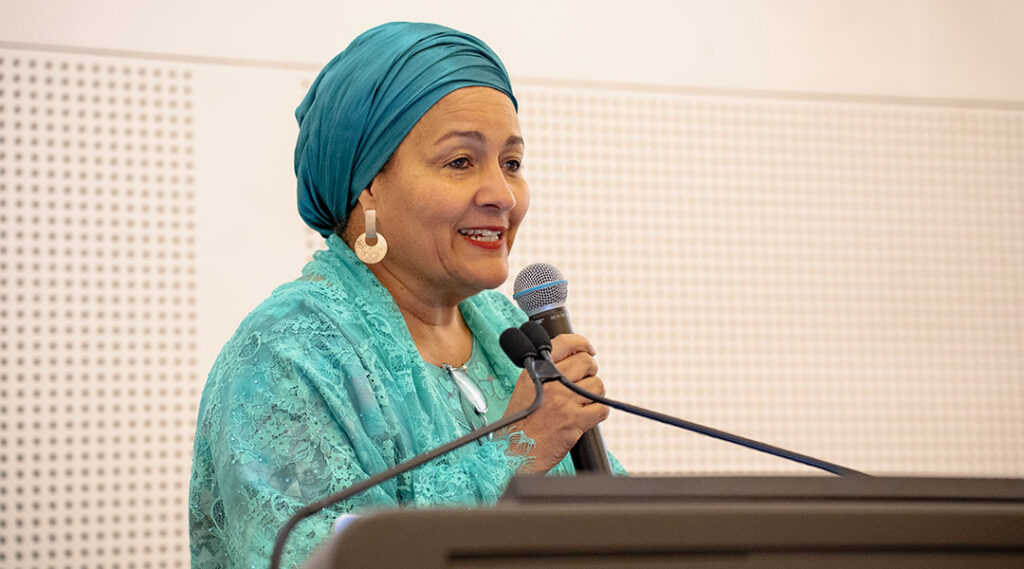
Ms. Amina J. Mohammed, UN Deputy Secretary-General, speaks at the UN80 DSG CSO Roundtable & Fishbowl at WD2026, a direct dialogue between civil society leaders and UN leadership on the UN80 Initiative, including the proposed merger of UNFPA and UN Women.
Multilateral reform and institutional accountability
UN Deputy Secretary-General Amina Mohammed held a direct dialogue with civil society leaders from around the world, locating the current moment within a longer arc of unfinished commitments. Her remarks were unsparing: the foundational gains of Beijing and Cairo remain contested, and the resources needed to defend them are shrinking. She addressed the proposed merger of UN Women and UNFPA as an opportunity to build a more coherent and accessible multilateral architecture for gender equality. Her remarks established a clear throughline for the Conference: institutional reform must serve movements, not replace them.
“Yet three decades after Beijing, thirty-one years after Cairo, we are still arguing with men over whether a woman’s body belongs to her. That is the work we inherited, and that is the work that has brought more than six thousand of you to Narrm.”
— Amina J. Mohammed, UN Deputy Secretary-General
Feminist leadership and political will
Numerous plenary speakers addressed the gap between political commitment and structural delivery. Australian Minister for Women Senator Katy Gallagher and former Canadian Prime Minister Justin Trudeau both addressed the conditions necessary for governments to meaningfully advance gender equality, including the primacy of community-informed decision-making over top-down reform. The sessions resisted performative framings of progress, centering instead the question of accountability when political will is under pressure.
“Politics has taught me to use the power of politics, but informed by community, to shape change and prove to women that their governments hear them and can respond to them.”
— Senator Katy Gallagher, Minister for Women, Australia
“The stories we see in democracies and in autocracies are increasingly narrow, increasingly short-term, increasingly undermining local institutions.”
— Justin Trudeau, Former Prime Minister of Canada
Climate justice and Pacific leadership
Held against the backdrop of COP31 preparations, the climate plenary centered Pacific voices and foregrounded community-led solutions to loss and damage. The framing was deliberate: frontline communities are not passive recipients of climate response but active architects of it. The session reinforced a broader Conference argument that climate action divorced from gender justice, and from the knowledge systems of those most affected, will fall short of what the moment demands.
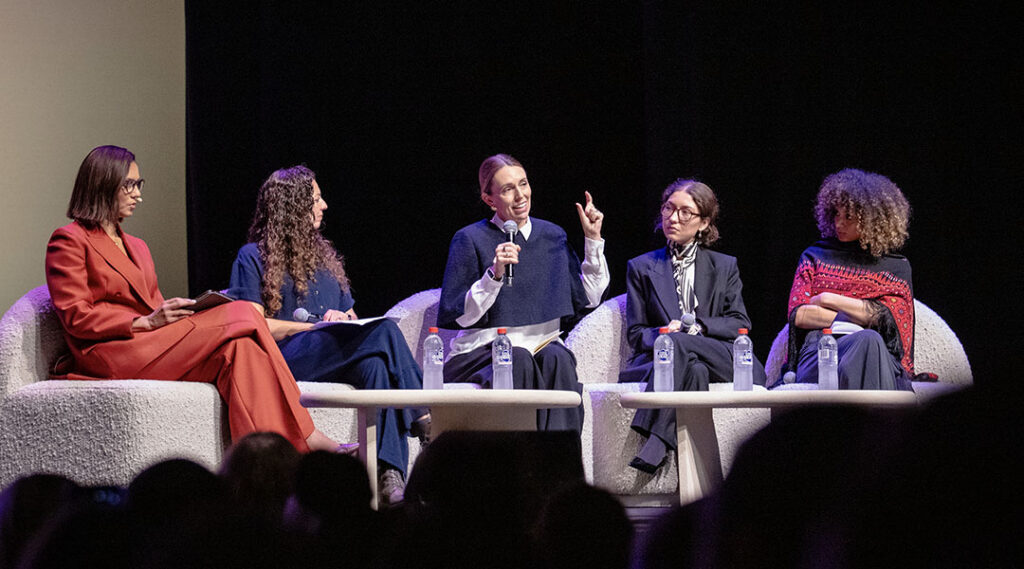
Dame Jacinda Ardern speaks during the “Women Are Not Negotiable: Conflict, Power, and Accountability” Plenary at WD2026.
“Climate change is not only damaging coastlines, it is reshaping the conditions in which violence against women happens at home and across the borders our people are crossing. Any honest conversation about community resilience must include both climate change and gender equity.”
— Hon Feleti Penitala Teo OBE, Prime Minister of Tuvalu
“It is important to ensure that civil society, especially young feminists, have a seat at the table, because the truth is, if we look at any major declaration, past or present, the answers didn’t always come from governments. These answers were drafted in the backrooms of conference halls by civil society. The COP process is the only process that we have at the moment, so it’s not a question of ‘will it deliver justice?’ — it must deliver justice.”
— Ms Ayshka Najib, Co-founder, Fridays For Future MAPA; MENA Regional Lead, Youth Climate Justice Fund
Conflict, accountability, and the limits of silence
The last thematic plenary at WD2026, Women Are Not Negotiable: Conflict, Power, and Accountability, was among the most significant sessions of the Conference. The panel brought together women with direct experience of displacement, conflict, and the failure of international protection systems. The session reflected a broader shift at WD2026: a willingness to name accountability failures in specific political terms, not only in abstract systemic ones.
“There is always something that you can do.”
— Dame Jacinda Ardern
TWO DAYS, 12 PRE-CONFERENCES
WD2026 opened with two days of Pre-Conferences, drawing more than 2,000 delegates into deep, focused dialogue before the main program began. The 12 sessions covered ground as wide as the movement itself, from “Decolonizing the Future: First Nations Indigenous Women Advancing Treaty and Global Solidarity” to a dedicated day for feminist changemakers advancing disability justice and a strategy session on ending sexual and gender-based violence. Additional themes included climate, youth, philanthropy, female genital mutilation/cutting (FGM/C), inclusive data, MenCare Cities, bodily autonomy, Girls Deliver, and Queers Deliver.
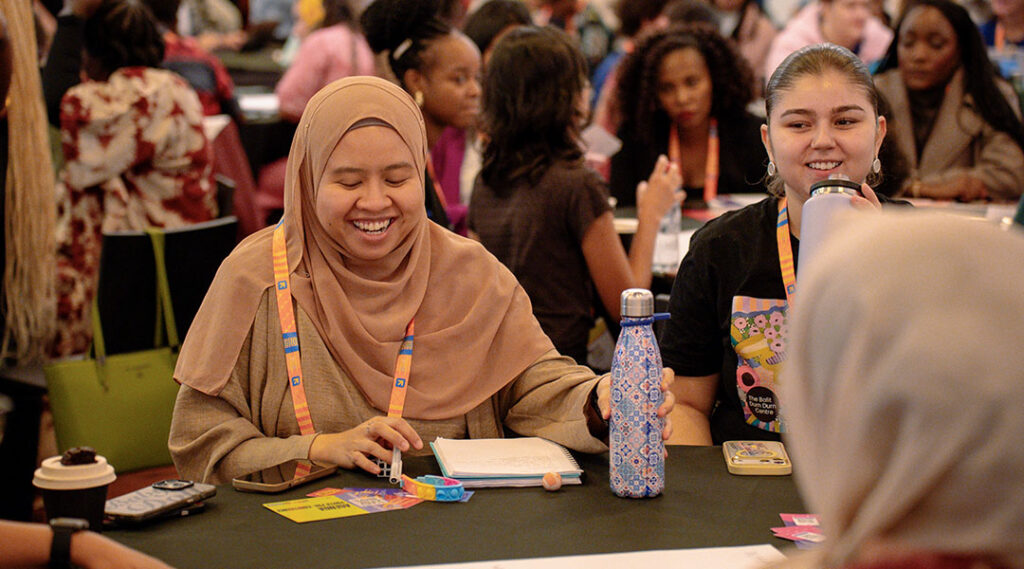
WD2026 delegates collaborate in workshop groups.
WD2026 was built from the ground up by young people. More than 100 full scholarships prioritized youth attendance, and young advocates held seats in every Working Group that informed the Conference’s programming and strategies. Youth voices were centered in Plenaries, Concurrent Sessions, Side Events, and beyond, with Women Deliver actively connecting youth advocates to speaking opportunities across the program.
The Youth Pre-Conference set the tone. More than 300 young attendees came together to lay out their priorities on financing — with funders and UN representatives listening and responding directly. The result was the Youth Deliver: 6 Key Priorities Document, a set of obligations already being referenced in other advocacy work, including Restless Development’s 10 Point Plan for Change.
That energy carried into the Youth Zone — a dedicated space for adolescent and youth delegates to build community, develop skills, and co-create interventions with real policy implications. Curated and led by a five-member Youth Planning Committee drawn from the Oceanic Pacific region, the Zone ran for three days across seven issue areas: mental health, social accountability, FGM/C, climate justice, gender justice, grassroots movements, and adolescent girls and youth leadership.

200+
adolescent and youth delegates across 3 days

10+
youth-led skills-building, knowledge-sharing, and collective action sessions

7
issue areas amplified

6
Youth-focused partner organizations co-led sessions, including Action Aid Australia, Pravah, AMREF Health Africa, Orygen, and Global Platform to End FGM

5-Member
Youth Planning Committee — designed and executed by young advocates from the Oceanic Pacific
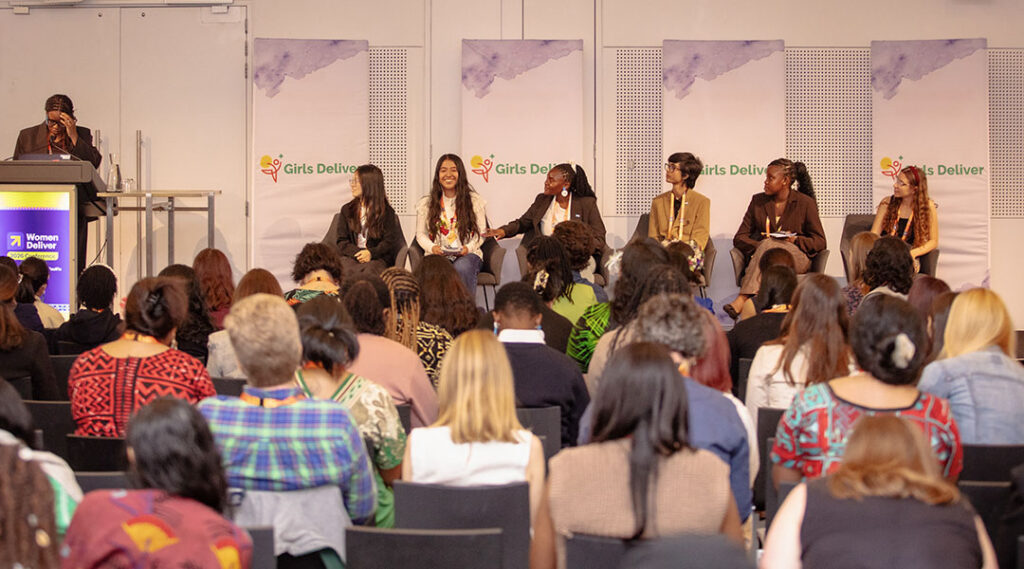
A Girls Deliver session brings young speakers together before a full audience.
More than 110 partner Side Events ran alongside the main program, giving activists, policymakers, and funders space to go deeper — through workshops, networking, and policy discussions that extended the conversations happening on the main stage.
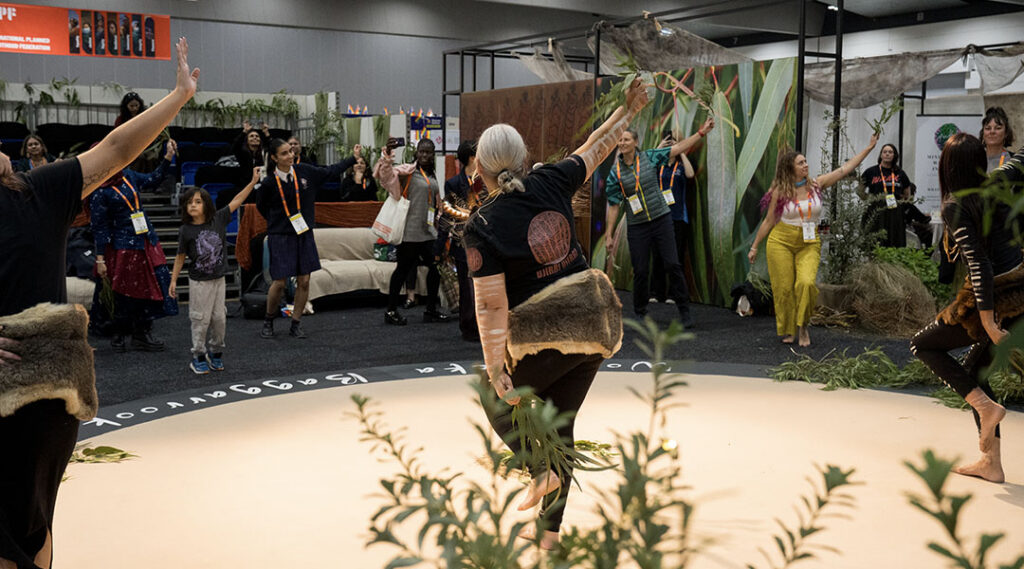
Participants join a cultural performance at the Baggarrook Biik Gathering Hub in the WD2026 Exhibition Hall.
More than 110 organizations transformed the exhibition floor into a dynamic hub for connection, learning, and action across 165 booths and eight dedicated hubs. At the Baggarrook Biik Gathering Hub, delegates joined weaving and yarning circles, the Wellness Mob, performances, and talks. Thematic conversations took place across the Climate & Gender Hub, Declaration Hub, Resourcing Hub, and Multilateralism Hub, while the Youth Zone brought together young advocates and the Arts Hub and Mind & Body Hub offered creative and restorative spaces including art workshops, dance, and yoga. A live mural wall, pickleball court, and recharge lounge completed the space.
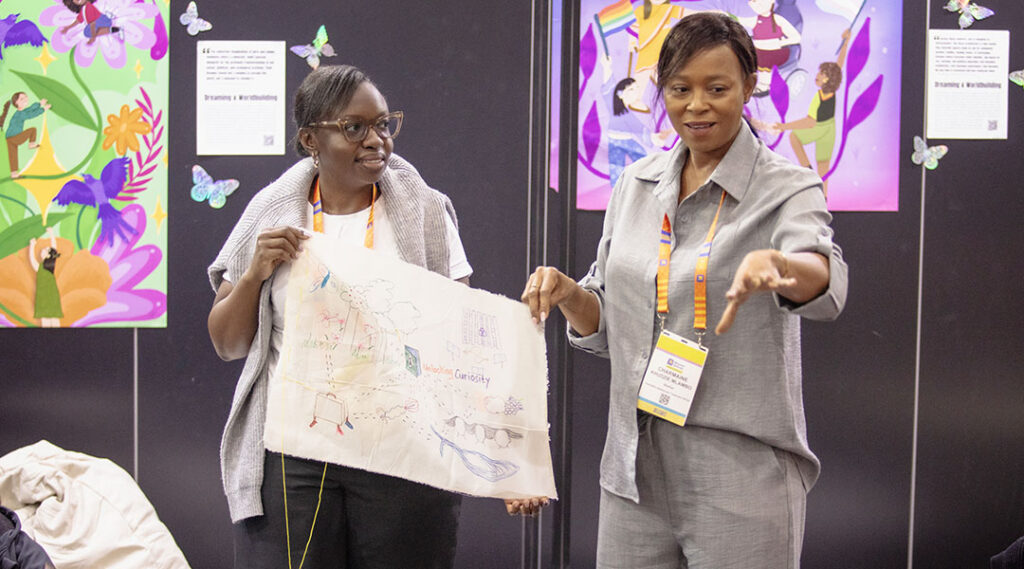
Participants present their collaborative artwork during a creative workshop in the WD2026 Arts Hub.
110+
Exhibitors across 165 booths

8 Hubs
Youth Zone | Climate & Gender Hub | Arts Hub | Declaration Hub | Baggarrook Biik Gathering Hub | Resourcing Hub | Mind & Body Hub | Multilateralism Hub
The Concurrent Program ran over 110 sessions, many of them taking new formats — fewer panels, more working groups, strategic discussions, and interactive workshops. A wide variety of topics were discussed including health, gender-based violence, climate, indigenous knowledge and leadership, education, economic justice, sexual and reproductive health and rights (SRHR), LGBTQI+ issues, artificial intelligence, political participation, and much more. Critically, cross-movement and cross-sector connections were made, where conversations on these topics were not had in silos, but understood as having interlocking root causes that demand integrated responses.
83% of session organizers rated their session 4 or 5 out of 5 for generating new knowledge, perspectives, or framings.
Not scarcity, choice
There was a broad consensus that existing resources are sufficient to address the crises; the problem is prioritization and political will, not scarcity. What is being made, openly or not, is a choice about whose safety matters and whose suffering is normalized.
The case for structural change
Across many Concurrent Sessions, a single diagnosis emerged: the systems in place are not accidentally inadequate — they were designed, or have evolved, to exclude. Structural change is not one demand among many, but the precondition for all others. Integrated programs, genuine participation, and sustained funding cannot be built on top of structures whose purpose is to concentrate power rather than distribute it.
The work of this moment is to name that clearly, and to insist, in every political and financial forum available, that redistribution of power is not a long-term aspiration but a fundamental requirement.
We too are powerful
Women’s rights movements tend to over-attribute power to the opposition and underestimate their own. Recognizing collective and individual power is a precondition for effective action.
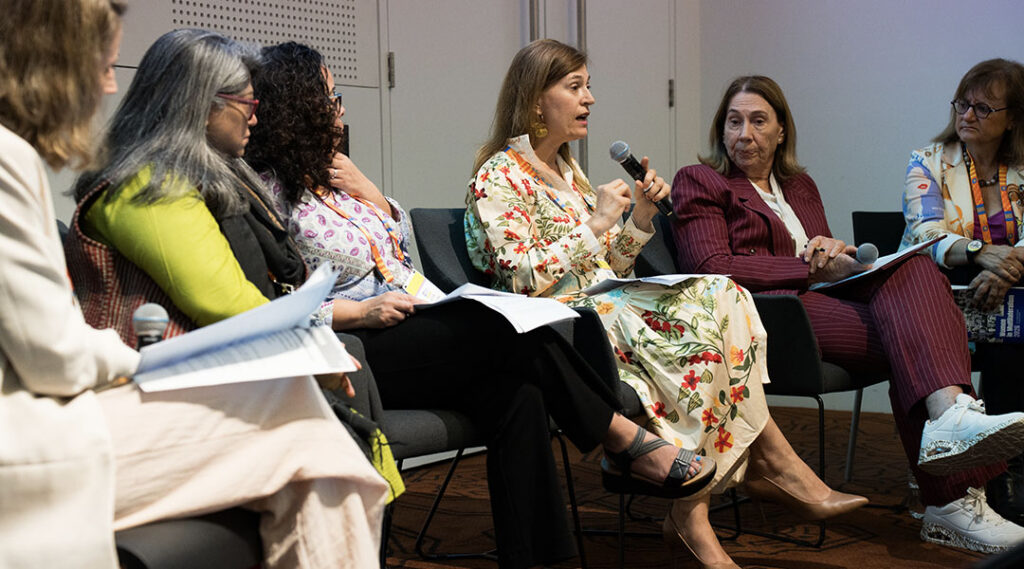
Panelists exchange insights during a Concurrent Session.
Session Highlight: The Long Game Calls Us Here
One session asked a question that doesn’t often make it onto Conference agendas: what is the cost of driving change while carrying unresolved conflict within yourself? The Long Game Calls Us Here brought together women changemakers to work through self-awareness, inner saboteurs, boundaries, and the relationship between internal and external conflict. The room was full of honest conversation — and the recognition that, scattered across the world, many of us are carrying the same voices in our heads.
“So much honest conversation. What it confirmed: we are profoundly similar while being profoundly unique, scattered across the world, sharing the same voices in our heads. The word I left with was quenched.”
— Monika Kawka, GoodOne
Session Highlight: POWER4Girls
The POWER4Girls session brought together girls, funders, and governments to explore how girls are stepping in to fill gaps in systems that were never built to serve them — while simultaneously advocating for those systems to change. The standing-room-only session has since catalyzed a dedicated funder learning space on resourcing girls in humanitarian contexts, hosted by Purposeful and UNICEF.
“The session highlighted an opportunity for further collective strategizing.”
— Georgia Booth, We Are Purposeful
Session Highlight: TFGBV Legislation Exists. So Why Are Young Women Still Unsafe?
When GRIT, UNFPA, and Our Watch brought their session to WD2026, it was grounded in child-led research on technology-facilitated gender-based violence (TFGBV). What followed was a genuine co-design process — each organization adapting to let the others contribute their expertise fully. The result was a stronger, more balanced session than any one organization could have built alone, and a partnership that has continued well beyond Narrm.
“The biggest outcome has been relational. Building something concrete together deepened our partnerships well beyond the Conference. The strongest collaborations were not necessarily the ones planned furthest in advance, but the ones where each organization was willing to adapt so everyone could contribute their expertise.”
— Session organizer
Session Highlight: EMILY’s List Australia
The EMILY’s List Australia session spent the majority of its time in small, facilitated groups, with participants from across the Asia-Pacific region working through one practical question: how do we get more women to run for parliament in our own contexts? Every participant left with at least one concrete action they had documented and committed to. The connections made in that room didn’t end when the session did — new relationships formed, particularly across Southern Africa, and have continued since Narrm, with participants sharing ideas, resources, and momentum toward gender-equal parliaments.
“Thank you for this unique and enriching opportunity to be part of a global movement.”
— Leonie Morgan AM, FAICD
