What Changed: Key Outcomes of WD2026
In one of the most constrained global environments the gender equality ecosystem has faced in decades, WD2026 generated a meaningful mix of financial, political, and partnership commitments — significant, and harder won than the numbers alone suggest.
The Melbourne Declaration for Gender Equality
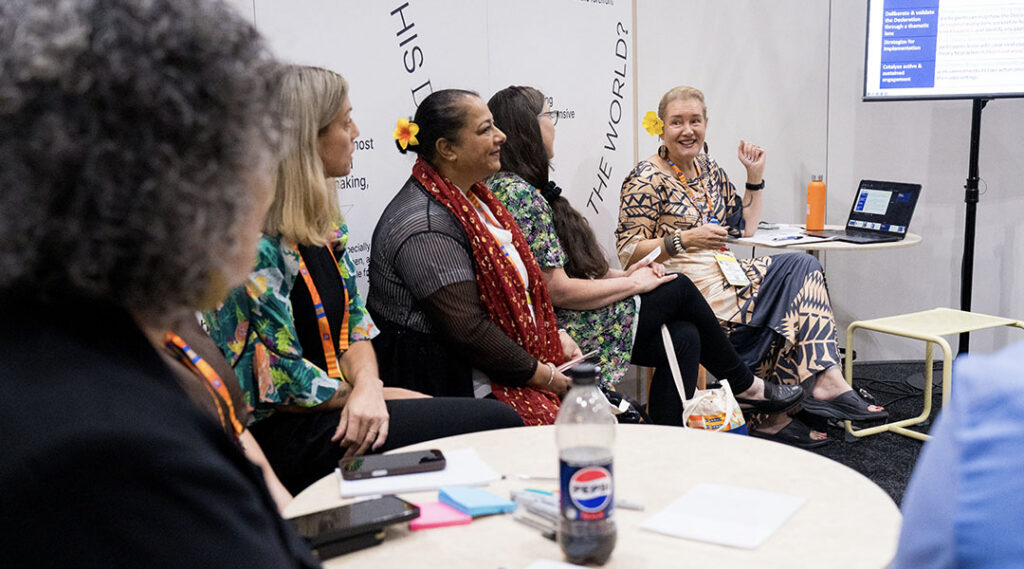
Small-group Melbourne Declaration consultation sessions in the Declaration Hub helped participants deliberate, validate, and strengthen collective advocacy priorities.
The Melbourne Declaration for Gender Equality emerged as WD2026’s clearest political anchor, giving everyone in the room — governments, institutions, civil society — something to be held to. It calls for a world where States respect, protect, and fulfill human rights; where feminist movements and civil society have the resources, space, and legitimacy to hold States accountable; and where the wider gender equality ecosystem aligns its resources and influence behind that work.
Shaped through more than 50 global consultations with more than 900 participants across regions, generations, and movements, the Declaration reinforces that the gender equality ecosystem must be rebalanced — away from donor-driven agendas and toward feminist movements, locally led organizations, and accountability to the people most affected by injustice.
At the time of writing, the Declaration has secured 829 endorsements, 318 of which are from organizations. Eleven governments have signed the related States Declaration, including Colombia, Canada, Finland, France, Iceland, Mexico, Norway, Slovenia, Spain, the United Kingdom, and Uruguay. Senior figures including UN Deputy Secretary-General Amina Mohammed, the Hon. Helen Clark, former Prime Minister of New Zealand, Governor-General of Australia Sam Mostyn AC, and the Hon. Julia Gillard, former Prime Minister of Australia, reinforced its themes in public remarks at and after the Conference.
The Declaration has already moved beyond Narrm — into ongoing conversations about accountability, democratic participation, and the urgent need for systems change across every region represented at WD2026.
Financial Commitments
Approximately US$1.8 billion in financial commitments were made at WD2026 — including US$218.5 million in new grant commitments, US$1.5 billion in catalytic finance expected to be mobilized, and US$23 million in continued support.
The Australian Government used WD2026 as a moment to announce US$90.2 million across women’s rights and SRHR priorities. Philanthropy showed up as an increasingly important source of catalytic support, with major commitments including:
- US$61 million from CIFF to help end child marriage
- US$32.8 million from a coalition of 11 Australian philanthropic funders to support women’s leadership and ending violence against women and children
- US$11.5 million from the Gates Foundation for adolescent girls
- US$23 million from Foundation CHANEL, the Dutch Ministry of Foreign Affairs, and others for Leading from the South, marking the partnership’s tenth anniversary
- US$2.5 million from Minderoo Foundation to the Global Institute for Women’s Leadership for research on gender equality and online misogyny
- Over US$77 million reaffirmed by Open Society Foundations for gender justice, as part of a broader US$300 million commitment supporting feminist movements, LGBTQI+ rights, and Indigenous and Afro-descendant communities
- US$1.5 billion to be mobilized through blended finance vehicles launched by AUDANEPAD in partnership with WHEN, focused on women’s health outcomes and economic agency across Africa
Partnerships and Initiatives
WD2026 also produced a set of launches that connected across sectors in ways that rarely happen at a single conference — linking gender equality to public finance reform, climate justice, Indigenous rights, health systems, and resistance to anti-rights narratives. Key launches included:
- The Feminist Health Systems Charter, launched by the PUSH campaign, Women Deliver, and partners, linked health systems reform to a broader rights and accountability agenda — described as the health-focused extension of the Melbourne Declaration.
- The First Nations and Indigenous Women’s Statement, launched at WD2026, delivered a powerful signal on sovereignty and transformation, insisting on a seat at the table and rejecting inclusion in systems that cause harm without structural change.
- The Manifesto for Adolescent Girls’ Rights, co-developed by Girls Deliver and youth partners, made a powerful call for a shift from symbolic inclusion to meaningful participation and accountability.
- The Adolescent Girls Era, a global campaign launched by 47 organizations to hold governments accountable, advance norms on girls’ rights, increase funding for girls and their allies, and ensure girls lead in decision-making spaces.
- The Prysm Initiative launched publicly as a new platform connecting high-net-worth philanthropists with high-impact reproductive health funding, backed by the Packard, Gates, and Hewlett foundations.
- PREVENT, a global coalition to prevent technology-facilitated gender-based violence, launched with Lotus Flower and partners.
- The UNDP Global Dialogue on Public Finance and Tax for Gender Equality signaled an expanded multi-actor alliance, with action plans from 28 countries and plans to scale to 40.
