Our History
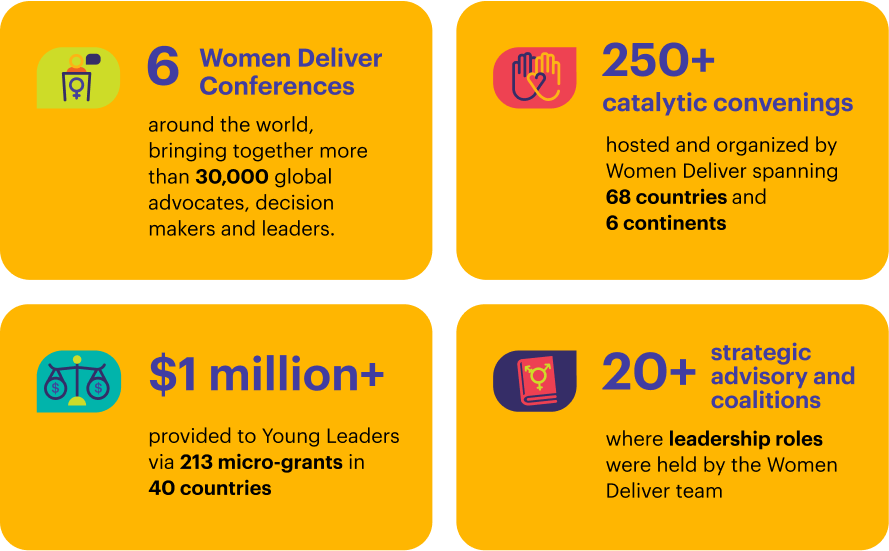
Since 2007, Women Deliver has championed change for gender equality on a global scale. Convening has always been central to our work: bringing people together across movements, regions, and generations to connect, collaborate, and advance collective action. Today, we are building on that foundation as a catalytic organization for the gender equality ecosystem.
These convenings matter because they create global stages and moments for those often excluded from decision-making and help build networks of advocates. It’s also where policies are negotiated, norms are challenged, and commitments by those in power are made.
Global convenings have had a particularly important impact on gender equality and women’s bodily autonomy. From the International Conference on Population and Development in Cairo (1994) to the Beijing Declaration and Platform for Action (1995), and continuing through Women Deliver Conferences, global spaces have translated advocacy into concrete policies and programs, shaping international agendas and creating real-world impact for girls, women, and gender-diverse people around the world.
We are experts in these spaces, where advocates, decision-makers, technical experts, and other actors come together to discuss critical global issues and create narratives, norms, and standards. We have a deep understanding of them: we know how to navigate their complex systems, we have access to them, and we aim to challenge and ultimately change whose voices are heard within them. In particular, we draw on years of experience meaningfully engaging young people and supporting collective action to advance their health and rights.
We are best known for this convening power — particularly Women Deliver Conferences, which began in 2007 when nearly 2,000 people from 115 countries declared that the deaths of over 500,000 women each year during pregnancy and childbirth would no longer be tolerated. The first Women Deliver Conference, held in London to mark the 20th anniversary of the Safe Motherhood Initiative, revitalized the case for investing in maternal and newborn health and intensified efforts to get maternal health on the global development agenda.
Our convening power has continued to grow since this first Conference in London, expanding to:
- Over 3,000 in 2010 (Washington, DC)
- 4,500 attendees in 2013 (Kuala Lumpur)
- 6,000 attendees in 2016 (Copenhagen)
- 8,000 onsite and 200,000 online and at satellite events in 2019 (Vancouver)
- More than 6,000 onsite and 10,000 online in 2023 (Kigali)
- More than 6,000 delegates from 189 countries in 2026 (Narrm/Melbourne)
2025–2030: Our Next Chapter
Our evolution accelerated following our organizational reckoning in 2020 and a period of profound disruption across the gender equality ecosystem that began in 2025. We have since reshaped our programming, structure, and goals and begun operating intentionally as a catalytic organization.
The Melbourne Declaration for Gender Equality demonstrates this role in practice: bringing diverse actors together around a shared political vision, building alignment, and creating the conditions for collective action. Our 2025–2030 Strategy builds on this foundation, deepening and expanding our catalytic role across the gender equality ecosystem.
Read Women Deliver’s 2025–2030 Strategy →