EARLY SIGNALS IMPACT REPORT
From convening to sustained collective action
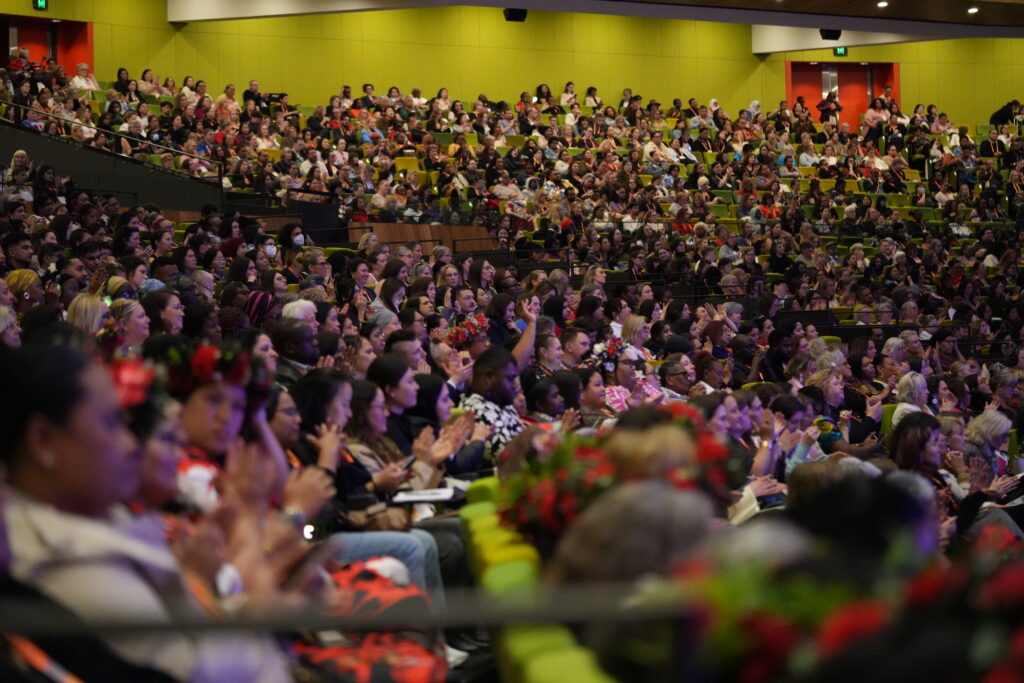
Delegates fill the auditorium ahead of the WD2026 closing ceremony.
A companion to the Women Deliver 2026 (WD2026) Post-Conference Report
Gender equality funding is shrinking. Anti-rights actors are gaining influence globally and rolling back hard-won rights. Against this backdrop, more than 6,000 people from 189 countries convened in Narrm (Melbourne), Australia, in April 2026 for the Women Deliver 2026 Conference (WD2026). While the WD2026 Post-Conference Report records what happened at the Conference, this report asks a different question: what might its early outcomes indicate about longer-term impact?
WD2026 brought together grassroots and youth advocates, civil society organizations, governments, funders, multilateral institutions, academia, media, and the private sector — actors with different levels of power, responsibility, and influence across the gender equality ecosystem. By bringing together these actors in the same space around a shared agenda, the Conference helped establish the Melbourne Declaration for Gender Equality as a shared political framework centered on three shifts: States meeting their human rights obligations; feminist movements and civil society having the resources, space, and power to hold them accountable; and the wider ecosystem aligning its resources and influence behind that work.
This breadth of participation, paired with shared political direction, created unusually strong foundations for collective action. Change in the gender equality ecosystem is rarely linear: advocacy, evidence, relationships, resources, and political will can converge in ways that expand what seems possible. WD2026 was designed to encourage this convergence amid growing division and backlash. While it is too early to claim that the ecosystem has transformed, the available evidence suggests that the Conference strengthened alignment, relationships, and the potential for sustained action.
This report assesses the early evidence against the Melbourne Declaration’s three shifts. It distinguishes between outcomes already documented around WD2026 and the longer-term changes that remain to be demonstrated in policy, funding practice, movement power, accountability, and institutional behavior.
The report does not attribute these outcomes solely to Women Deliver. The commitments, alliances, financing, and political processes described below were led and advanced by movements, governments, funders, advocates, and institutions, often through years of work. Women Deliver’s contribution was catalytic: co-creating a shared political direction, connecting actors and initiatives, increasing the visibility of partner-led work, and using WD2026 as a global stage and advocacy moment to concentrate attention and encourage commitments.
